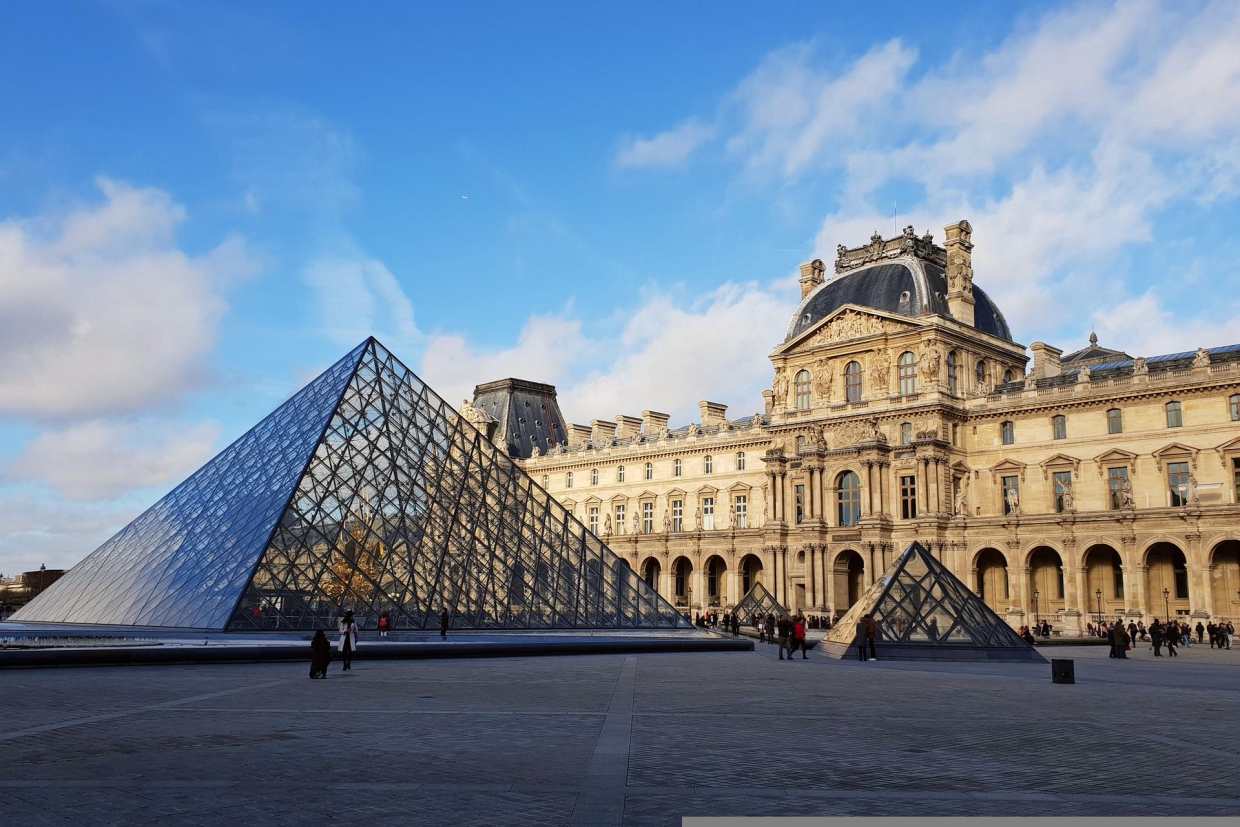
Walk in the footsteps of French monarchs in a building that is a masterpiece in itself. Explore the architectural evolution of the Louvre, from its origins as a medieval fortress to its glory days as a royal residence. Admire the stunning contrast of the Cour Napoléon, where the classical palace façade meets the contemporary brilliance of I.M. Pei’s iconic Glass Pyramid.
A Monument in Constant Evolution
The Louvre is not merely a container for art; it is perhaps the most fascinating artifact in the entire collection. Its walls bear witness to over 800 years of French history, evolving from a defensive stronghold to a symbol of modern culture.
The Medieval Roots Your exploration of the architecture should begin deep underground in the Sully Wing. Here, you can walk around the original dry moat and the base of the massive keep built by King Philippe Auguste in 1190. These stone foundations remind visitors that before it was a palace of beauty, the Louvre was a fortress of war, designed to protect Paris from invaders.
The Residence of Kings As the city grew, the fortress lost its military purpose. In the 16th century, King Francis I demolished the old keep and began transforming the grim castle into a luxurious Renaissance palace. For centuries, this was the primary residence of French monarchs. As you walk through the Cour Carrée (Square Court), admire the intricate stone carvings that celebrated the power of the monarchy long before Louis XIV moved the court to Versailles.
The Pyramid: A Modern Controversy The most striking chapter in the Louvre's architectural history was written in 1989. Commissioned by President François Mitterrand, architect I.M. Pei designed the iconic Glass Pyramid. At the time, placing a futuristic structure of glass and steel in the center of a classical courtyard caused a national scandal.
Today, however, it is accepted as a masterpiece. The Pyramid not only solved the museum's congestion problems by creating a spacious central entrance but also floods the underground lobby with natural light. It stands as a perfect symbol of the Louvre today: a bridge connecting the historic past with the vibrant present.